Why Is My Tankless Water Heater Not Getting Hot?
Lukewarm showers in Newport Beach usually trace back to scale buildup, an undersized gas line, or a flow rate that outruns the unit. Here is how we diagnose and fix each one.
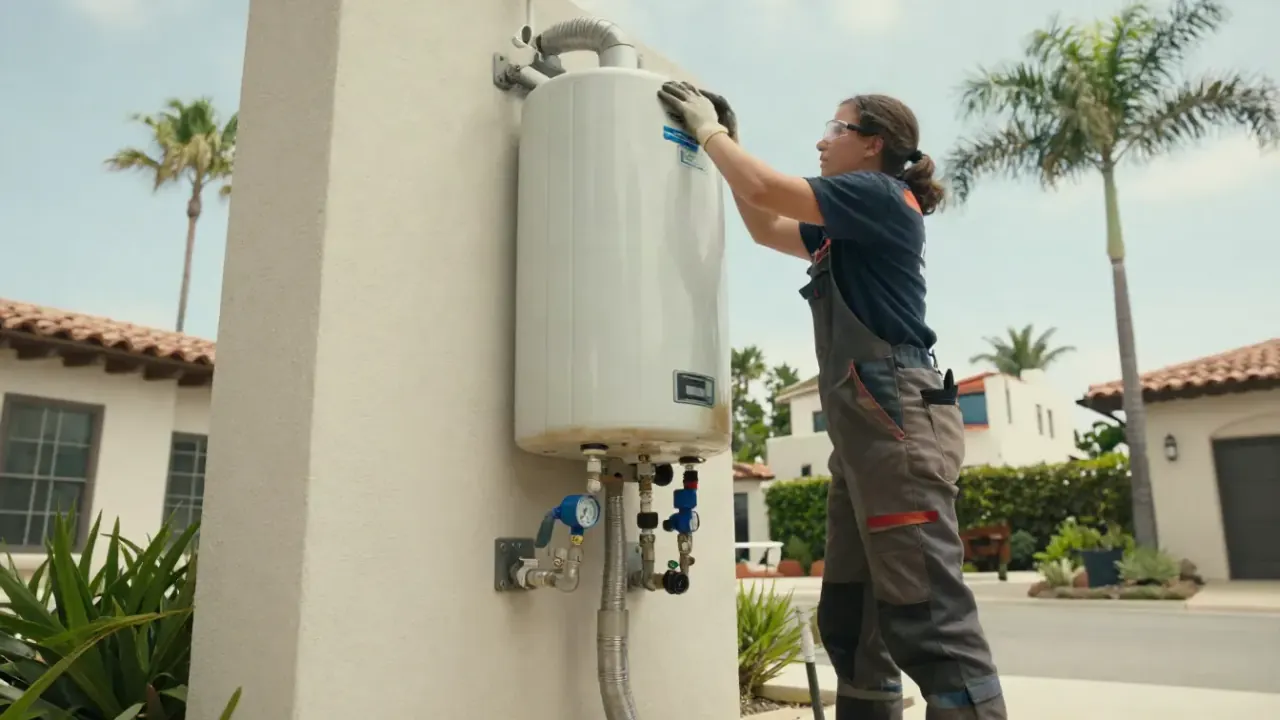
Your tankless water heater is not getting hot because the unit is either not firing at all, firing but not transferring enough heat to the water, or being asked to heat more water than its rated capacity allows. In Newport Beach, the most common culprit by a wide margin is mineral scale inside the heat exchanger - our hard Colorado River-sourced water leaves calcium deposits that insulate the coils and drop outlet temperature by 10 to 25 degrees over 18 to 24 months. The second most common cause is an undersized gas line that starves the burner during high-demand showers.
Below we walk through the seven causes we actually find on service calls across Newport Beach, what each one looks like from your side of the faucet, and which fixes you can handle yourself versus which ones need a licensed technician.
The Short Answer: Why Your Tankless Unit Runs Cold
A tankless water heater not getting hot in Newport Beach CA is almost always a scale, gas, or flow problem - not a dead unit. Tankless water heaters are on-demand appliances that heat water as it passes through a copper heat exchanger; if that exchanger is coated in scale, if the gas supply is too small, or if the incoming water is moving faster than the burner can heat it, the outlet temperature drops even though the unit is technically working.
Here is the diagnostic order we use on every call, from cheapest to most expensive to fix:
- Check the display and error codes. A code like 11, 12, or 90 tells you the unit already knows something is wrong.
- Check the inlet water temperature. In October, Newport Beach groundwater sits around 62-66°F. If it is much colder, the unit has to work harder.
- Check the flow rate. Two showers plus a dishwasher can push past 6 GPM, which is more than many residential units can heat to 120°F.
- Check for scale. If the unit is over 18 months old and has never been flushed, this is your answer 70% of the time.
- Check gas pressure and line size. A 3/4-inch line feeding a 199,000 BTU unit over 40 feet is a common failure point in older Newport Beach homes.
If you want a baseline understanding of how these systems are supposed to perform before you start troubleshooting, our overview of the best Tankless Water Heater in Newport Beach covers sizing, flow rates, and what a properly installed unit should deliver.
Hard Water Scale Is the Number One Cause in Newport Beach
Hard water scale is the single most common reason a tankless water heater in Newport Beach stops reaching its set temperature. Our municipal water supply comes largely from the Colorado River and the State Water Project, and it carries 8 to 12 grains per gallon of hardness - enough to leave visible calcium on showerheads within a year and enough to coat a heat exchanger in 18 to 24 months.
Here is what scale does inside the unit. The heat exchanger is a series of copper tubes with water on one side and a 150,000-plus BTU burner on the other. Scale builds up on the water side, and because calcium carbonate conducts heat about 400 times worse than copper, the burner's heat never fully reaches the water. The unit still fires. The display still reads 120°F. The water coming out is 98°F.
You can spot scale without opening the unit:
- Outlet temperature drops 5-10°F over a few months, then 15-25°F.
- You hear a rumbling or kettling sound during long draws.
- White crust appears on the inlet filter screen or the condensate trap.
- The unit throws a code 11 or 12 (no flame or flame failure) intermittently.
The fix is a proper descaling flush - pumping food-grade white vinegar or a commercial descaler through the heat exchanger for 45 to 60 minutes at 2 to 3 GPM. We handle this with our Tankless Flush & Descaling Newport Beach CA service, and for most Newport Beach homes the right interval is once every 12 months. Skip it and you will be replacing the heat exchanger or the whole unit at year five instead of year fifteen.
Your Gas Line May Be Undersized for the Unit
An undersized gas line is the second most common cause of a tankless water heater not hot enough in Newport Beach CA, and it is the one homeowners almost never guess. Tankless units pull 150,000 to 199,000 BTU per hour when running - roughly three to four times what a tank-style heater draws. If the gas line feeding the unit was sized for the old tank heater, the burner cannot get enough fuel to hit full modulation.
The symptom is specific. The unit fires, runs for 30 to 90 seconds, then either shuts off or drops to a low flame. You get a burst of hot water, then lukewarm, then hot again. On cold mornings the problem is worse because the incoming water is colder and the burner needs to run harder.
Three things to check before you assume the unit is bad:
- Line size. A 199,000 BTU unit needs 3/4-inch black iron or CSST for runs up to 40 feet. Beyond that, 1-inch is often required.
- Meter capacity. Older Newport Beach homes on Balboa Island and the Peninsula sometimes have 250 CFH meters that cannot feed a tankless unit plus a furnace plus a range at the same time.
- Static and dynamic pressure. We want 7 to 10 inches of water column static, and no more than a 1.5-inch drop when the unit fires.
When the line is the problem, we run a dedicated 3/4-inch or 1-inch line from the meter to the unit. That is what our Gas Line Upgrades for Tankless Heaters Newport Beach CA service covers, and it is a one-day job in most cases.
Flow Rate and the 'Cold Water Sandwich'
Flow rate is the third major cause, and it is the easiest to test yourself. A tankless unit is rated for a specific temperature rise at a specific flow. A typical 199,000 BTU residential unit delivers about 4.5 to 5.5 GPM at a 60°F rise - enough for two showers in October when inlet water is 64°F, but not enough for two showers plus a washing machine plus a kitchen sink.
Run this test. Turn on one hot faucet and set the unit to 120°F. Measure the outlet temperature with a meat thermometer under the stream. Now turn on a second hot fixture and measure again. If the temperature drops more than 8°F, you are exceeding the unit's capacity - not dealing with a broken heater.
The 'cold water sandwich' is a related but separate issue. When you turn a hot tap off and on quickly, the unit shuts down and restarts, and the cold slug of water sitting in the pipe between the heater and the fixture comes through first. You feel 10 to 20 seconds of cold water, then hot. This is normal behavior on any tankless system and is not a repair issue - but if it lasts longer than 30 seconds, your unit may be short-cycling and needs a look.
We see this pattern constantly in the older beach cottages around Tankless Water Heater in Balboa Island, where long pipe runs and single-bathroom layouts make the sandwich more noticeable than it would be in a newer build.
Error Codes and Ignition Failures
Error codes are the unit telling you exactly what is wrong, and ignoring them is the fastest way to turn a $250 repair into a $1,800 replacement. Every major brand - Rinnai, Navien, Noritz, Takagi, Rheem - uses a numeric code system, and while the numbers vary by manufacturer, the categories are consistent.
Codes that mean 'not getting hot':
- Code 11 (Rinnai) / E003 (Navien): ignition failure. Usually a dirty flame rod, a clogged burner, or low gas pressure.
- Code 12 (Rinnai) / E012 (Navien): flame failure after ignition. Often a gas supply issue or a blocked intake.
- Code 90 / E090: scale buildup or a blocked heat exchanger - the unit is protecting itself.
- Code 10 / E010: air intake or exhaust blockage. On Newport Beach units, this is frequently a bird nest or spider web in the vent termination.
Before you call anyone, do three things. Kill power at the breaker for 30 seconds and restart. Check that the gas shutoff valve at the unit is fully open. Look at the vent termination outside - if you see debris, clear it. If the code returns within an hour, the problem is internal. Our Tankless Error Code Troubleshooting Newport Beach CA service is built around pulling the exact code history off the unit's board rather than guessing.
Common Mistakes We See Homeowners Make
The most expensive mistake is ignoring a temperature drop for months and assuming it will fix itself. It will not. Scale only thickens, and a heat exchanger that could have been descaled for a few hundred dollars gets replaced for well over a thousand.
Other mistakes we run into weekly:
- Turning the setpoint up to 140°F to compensate. This forces the unit to work harder, accelerates scale, and creates a scald risk - especially in homes with young kids or older adults.
- Installing a new unit on the old undersized gas line. We have pulled units that were replaced twice in three years because nobody checked the line.
- Using the wrong descaler. Muriatic acid or pool acid will destroy the heat exchanger. Food-grade white vinegar or a purpose-made descaling solution only.
- Skipping the inlet filter. The small screen on the cold-water inlet catches grit and debris. If it is clogged, flow drops and the unit short-cycles.
- Assuming 'tankless' means 'maintenance-free.' It does not. Annual service is what gets these units to their 15- to 20-year lifespan.
If your unit is more than 15 years old and has never been descaled, replacement is usually the smarter spend. Our Tankless Water Heater Replacement in Newport Beach, California service includes a full gas and vent inspection so the new unit is not inheriting the old problems.
When to Call a Professional
Call a licensed technician when the unit throws a code that returns after a power cycle, when the outlet temperature is more than 15°F below the setpoint, when you smell gas, or when you see water pooling under the unit. Those four symptoms cover roughly 90% of the calls we run.
We are Newport Beach Tankless Water Heater, and we work on every major brand - Rinnai, Navien, Noritz, Takagi, Rheem, Bosch, and Stiebel Eltron. Our technicians carry descaler pumps, combustion analyzers, and manometers on every truck, so we can diagnose scale, gas pressure, and venting in a single visit instead of scheduling three. We quote the repair before we start, and we tell you honestly when a flush will fix it versus when you are better off replacing.
If you are in Corona del Mar, Newport Coast, or anywhere along the harbor, we are usually on-site the same day. Homeowners in the older hillside neighborhoods deal with a specific set of issues - long gas runs, original 1960s piping, and venting that was never updated - and we see them often enough that we know what to look for before we open the panel. That is also true for the homes we service with Tankless Water Heater in Corona del Mar, where steep lots and coastal air add their own wrinkles.
Frequently Asked Questions
Why is my tankless water heater not getting hot in Newport Beach CA?
Scale buildup inside the heat exchanger is the answer about 70% of the time in Newport Beach, because our water runs 8-12 grains per gallon hard. Undersized gas lines and flow rates that exceed the unit's GPM rating account for most of the rest. A code 11 or 12 on the display usually confirms an ignition or gas issue.
How do I fix a tankless water heater that won't get hot in Newport Beach?
Start with a power cycle, confirm the gas valve is fully open, and clear any debris from the outdoor vent. If the outlet temperature is still more than 15°F below your setpoint, the unit needs a descaling flush or a gas pressure test - both of which require a technician with the right pump and manometer.
Does hard water cause tankless water heater temperature issues in Newport Beach California?
Yes, and it is the leading cause. Newport Beach water carries 8-12 grains per gallon of hardness, which deposits calcium on the heat exchanger within 18-24 months. That scale insulates the coils and drops outlet temperature 10-25°F. An annual descaling flush prevents it.
Who repairs tankless water heaters not getting hot in Newport Beach?
Newport Beach Tankless Water Heater repairs every major brand - Rinnai, Navien, Noritz, Takagi, Rheem, and Bosch - with same-day service across Newport Beach, Corona del Mar, Balboa Island, and Newport Coast. We carry descaler pumps and combustion analyzers on every truck.
How often should a tankless water heater be flushed in Newport Beach?
Once every 12 months for most Newport Beach homes, and every 8-10 months if you are on the Peninsula or Balboa Island where the water is hardest. Skipping the flush is the single fastest way to cut a 20-year unit's life down to 6 or 7 years.
Get Help With Tankless Water Heater in Newport Beach
Lukewarm showers are almost always fixable the same day, and the sooner we get eyes on the unit, the cheaper the repair. Call Newport Beach Tankless Water Heater at (949) 670-0280 and we will diagnose the cause, quote the fix, and get your hot water back - usually in one visit.