Tankless Water Heater Venting Explained
How tankless venting actually works in Newport Beach: PVC vs stainless, clearances, condensate drains, 2026 costs, and the mistakes we fix most often.
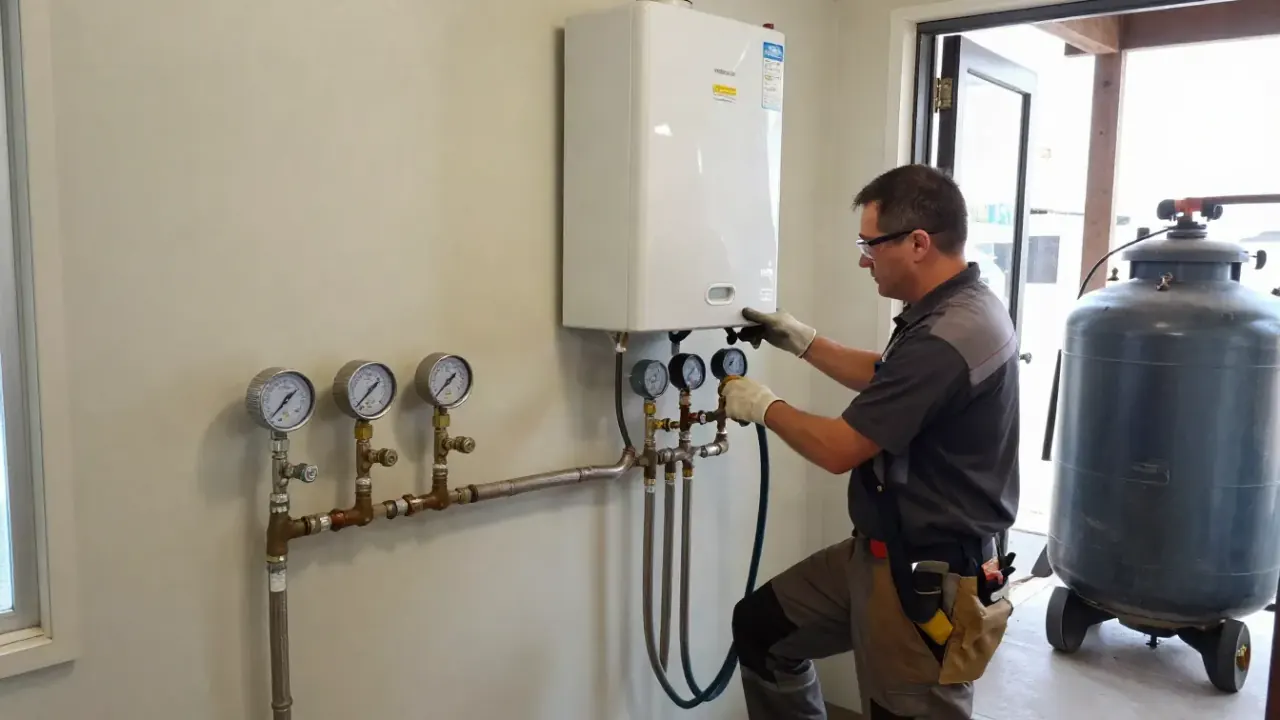
Tankless water heater venting is the system that carries exhaust gases and acidic condensate out of your home through a sealed pipe, and it is the single most code-sensitive part of any tankless install in Newport Beach. Get the material, slope, or clearance wrong and the unit either refuses to fire or fails inspection. This guide covers how venting works, what Newport Beach and Orange County code actually requires, what it costs in 2026, and the mistakes we see on nearly every second call.
If you are comparing installers, start with a company that does this every week. We handle Tankless Water Heater Newport Beach CA work daily, from single-family homes on the Balboa Peninsula to hillside properties up in Newport Coast.
How does tankless water heater venting work in Newport Beach CA?
Tankless water heater venting in Newport Beach works by pulling combustion air in through one pipe and pushing exhaust out through another, or by using a concentric pipe that does both through a single penetration. A blower inside the unit forces the exhaust through a sealed, gasketed pipe that runs to an exterior wall or roof cap. There is no chimney, no draft hood, and no reliance on rising hot air the way a tank heater works.
That sealed design is why tankless units can be mounted almost anywhere - a closet, a garage wall, even inside a cabinet - as long as the vent run stays within the manufacturer's maximum length. Most residential units allow 35 to 50 equivalent feet of pipe, and every 90-degree elbow counts as 5 to 8 feet against that total. Two elbows and a 12-foot run is nothing. Four elbows and a 30-foot run will trip a fault code.
The unit monitors airflow with a pressure switch. If the vent is blocked, kinked, or undersized, the heater shuts down and throws an error code instead of running dirty. That is a safety feature, not a malfunction.
Condensing vs non-condensing: the vent material decision
Condensing tankless heaters run at 95% or higher efficiency and produce acidic condensate that will eat through standard galvanized pipe in a couple of years. Non-condensing units run at 80% to 83% and exhaust hot enough that the moisture stays vaporized.
That difference decides your vent material:
- Condensing units: Schedule 40 PVC, CPVC, or polypropylene (certified to ULC S636). PVC is the cheapest and the most common in Orange County.
- Non-condensing units: Category III stainless steel, usually 4-inch, with a listed cap.
PVC on a non-condensing unit is a code violation and a melt risk. Stainless on a condensing unit is legal but wasteful - you are paying three to four times the material cost for no benefit. We see both mistakes on DIY installs.
What are the venting requirements for a tankless water heater in Newport Beach?
The venting requirements for a tankless water heater in Newport Beach come from the California Plumbing Code, the California Mechanical Code, and the manufacturer's installation manual - and the strictest of the three wins. Newport Beach also sits in a coastal salt-air zone, which matters for termination hardware.
The numbers that get checked at inspection:
- Clearances: 12 inches minimum above grade, 12 inches from any door or window that opens, 3 feet from a gas meter or regulator, and 4 feet from any fresh-air intake.
- Slope: Condensing vents slope back toward the unit at 1/4 inch per foot so condensate drains into the built-in trap, not out the termination.
- Support: Horizontal runs need hangers every 4 feet. Sagging pipe collects water and freezes the pressure switch.
- Termination: Must be a listed cap for that specific unit. A generic dryer vent cap does not pass.
- Penetration sealing: Every wall or roof penetration gets sealed and flashed. In coastal Newport Beach, use stainless or coated hardware - plain steel rusts out in two or three seasons.
If you are converting from a tank heater, the old flue almost never lines up with the new vent path. That is why most conversions need a fresh penetration, which is part of what we scope on a Tank-to-Tankless Conversion Newport Beach CA.
Can I vent a tankless water heater through a wall in Newport Beach CA?
Yes - horizontal through-wall venting is the standard method in Newport Beach and most of coastal Orange County. Roof venting is only used when the unit sits in an interior closet with no exterior wall within the allowable run.
Two things trip people up here. First, the wall you pick has to be clear of windows, doors, and the neighbor's property line. On tight lots in Balboa Island Tankless Water Heater properties, that often means running the vent up and out rather than straight back. Second, the exterior termination has to sit high enough that ocean spray and irrigation runoff do not enter it. We set terminations at 18 inches above grade as a rule, even though 12 is the minimum.
If your unit is going on an exterior wall, the vent run is usually short and cheap. If it is going in a garage or interior closet, expect more pipe, more elbows, and a longer install day.
Tankless water heater condensate drain Newport Beach: the part nobody warns you about
A tankless water heater condensate drain in Newport Beach has to move roughly 1 to 2 gallons of acidic water per day out of the unit and into a legal drain point. That water has a pH around 3 to 4 - about the same as vinegar - and it will corrode copper, kill landscaping, and stain concrete if it is just dumped outside.
Legal drain points:
- An indirect waste line to a laundry standpipe or utility sink
- A floor drain tied to the sanitary sewer
- An exterior drain with a neutralizer kit approved for the unit
What does not work: dripping onto the roof, running into a planter, or tying directly into a copper line. We see all three. The fix is a neutralizer cartridge (about $60 to $120 in parts) plus a proper trap and slope. If you have ever noticed a white chalky crust under your heater, that is condensate damage starting.
Because this is a plumbing job as much as a venting job, we handle both under one scope with Tankless Venting & Condensate Drain Installation Newport Beach CA.
Common venting mistakes we fix in Newport Beach
Most venting failures we get called out for are not exotic. They are the same five errors, over and over.
- Reusing the old tank flue. A 4-inch galvanized B-vent from a 1990s tank heater cannot handle a condensing tankless unit. It corrodes from the inside out.
- Too many elbows. Every 90 adds 5 to 8 equivalent feet. A run that looks short on paper can exceed the max before it leaves the closet.
- Wrong slope. Flat or back-sloped pipe traps condensate, and the unit starts throwing airflow codes within weeks.
- Unsealed penetrations. Beyond code, this is how salt air and moisture get into your wall cavity in coastal Newport Beach.
- Condensate dumped outside. Kills plants, stains stucco, and fails inspection.
If your unit is already throwing codes, the vent is one of the first things we check. Airflow faults are the most common reason we get called for Tankless Error Code Troubleshooting Newport Beach CA, and roughly half of those turn out to be vent-related rather than a failed part.
When to call a professional
Call us when the vent run involves a wall or roof penetration, when you are converting from a tank heater, when the unit is throwing airflow or condensate codes, or when you simply cannot find a legal termination point on your property. Those are the four situations where DIY goes wrong most often.
Newport Beach Tankless Water Heater installs and repairs venting across the peninsula, the islands, and the inland neighborhoods. We pull the permit, run the vent to code, tie in the condensate drain, and test the unit under load before we leave. If you are in a hillside neighborhood like Newport Coast Tankless Water Heater territory, we also check wind exposure at the termination - coastal gusts can push exhaust back into the intake on a badly placed cap.
Frequently Asked Questions
How does tankless water heater venting work in Newport Beach CA?
A blower forces exhaust through a sealed pipe to an exterior wall or roof cap while combustion air comes in through a second pipe. The unit's pressure switch monitors airflow and shuts the heater down if the vent is blocked or undersized. Runs are limited to 35 to 50 equivalent feet depending on the model.
What are the venting requirements for a tankless water heater in Newport Beach?
California Plumbing and Mechanical Code plus the manufacturer's manual govern the install. Key numbers: 12 inches above grade, 12 inches from any opening window or door, 3 feet from a gas meter, 4 feet from a fresh-air intake, and 1/4-inch-per-foot slope on condensing vents. The strictest of the three sources wins.
Can I use PVC to vent a tankless water heater in Newport Beach California?
Yes, if the unit is condensing - which is most models sold today. Use Schedule 40 PVC, CPVC, or ULC S636 polypropylene. Non-condensing units require Category III stainless steel instead. Putting PVC on a non-condensing unit is a code violation and a melt risk.
Who installs tankless water heater venting in Newport Beach?
A licensed plumbing contractor with tankless experience. It is not a handyman job - the vent ties into the unit's warranty, the permit, and the condensate drain. We handle the full scope: vent, gas line, water connections, and final testing.
How much does tankless venting cost in Newport Beach in 2026?
Typical 2026 pricing runs $450 to $900 for a straightforward through-wall PVC vent on a condensing unit, and $900 to $1,800 when the run needs a roof penetration, a neutralizer kit, or a longer pipe path. Reusing an old flue is not an option on condensing units.
Get help with Tankless Water Heater in Newport Beach
Venting is the part of a tankless install that decides whether the unit runs for fifteen years or throws codes every winter. We do it to code, pull the permit, and test under load before we leave.
Call Newport Beach Tankless Water Heater at (949) 670-0280 to schedule a vent inspection or a full install.