Tankless Water Heater and Hard Water in Orange County
Orange County water runs 8-18 grains per gallon of hardness. Here is how that scale builds up inside your tankless heater, what it costs you, and how often to descale.
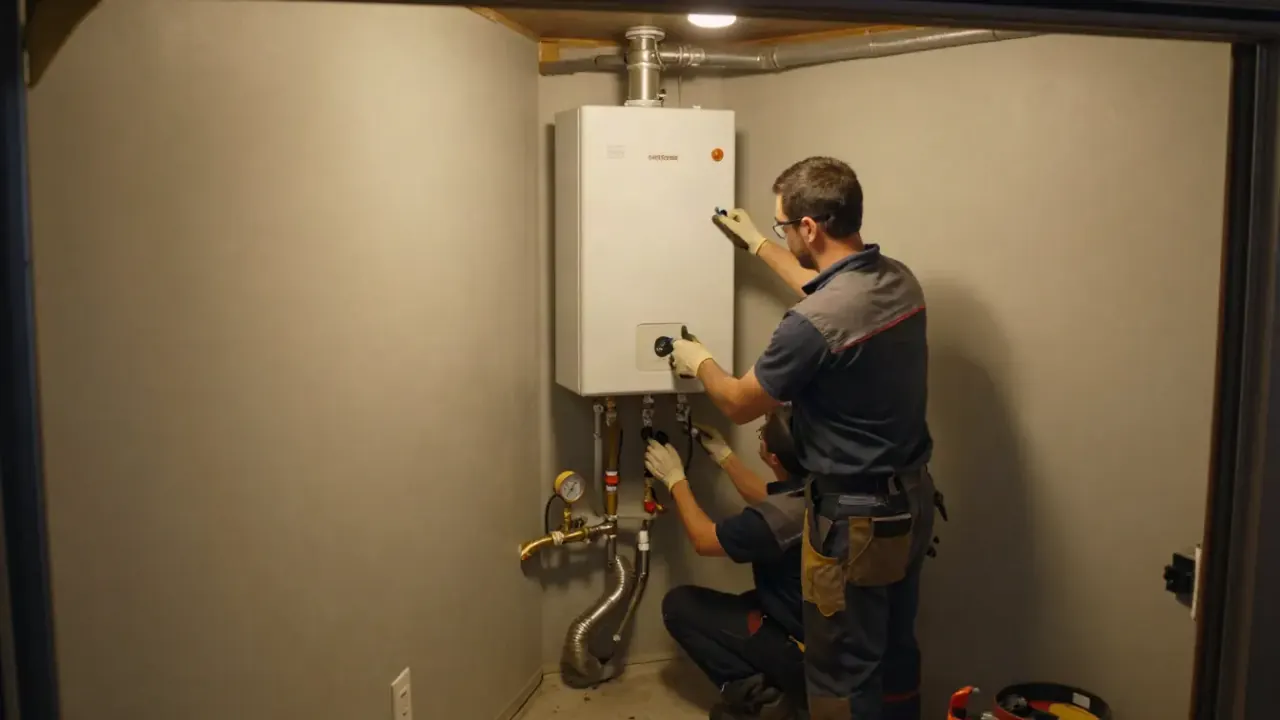
Hard water is the single biggest reason tankless water heaters in Orange County lose efficiency, throw error codes, and get replaced years before they should. The water coming out of Newport Beach taps runs roughly 8 to 18 grains per gallon of dissolved calcium and magnesium, which is firmly in the hard-to-very-hard range on any water quality scale. That mineral load does not care how good your heater is. It coats the heat exchanger every time you run hot water, and it never stops.
Below we break down what that means for your unit, how often it needs descaling, whether a softener is worth the money, and the mistakes that cost homeowners here the most. We install, repair, and descale tankless systems across Newport Beach and the surrounding Orange County coast, so this is what we see in the field rather than what a brochure says.
How Hard Is the Water in Newport Beach and Orange County?
Newport Beach and most of coastal Orange County draw from the Metropolitan Water District blend, which lands between 8 and 18 grains per gallon depending on the year and the mix of imported Colorado River and State Water Project supplies. Anything above 7 grains per gallon is classified as hard. Above 10.5 is very hard. Most of Newport Beach sits right in the middle of that very-hard band.
Hardness is measured in grains per gallon (gpg) or milligrams per liter (mg/L) of calcium carbonate. One grain per gallon equals about 17.1 mg/L. So a reading of 12 gpg is roughly 205 mg/L, which is enough to leave visible white crust on faucet aerators within a few weeks and enough to scale a tankless heat exchanger in a single heating season.
Here is what we typically measure across the areas we serve:
- Newport Beach, Corona del Mar, Balboa Island: 9-14 gpg, occasionally higher in summer when the imported blend shifts.
- Irvine and Costa Mesa: 10-16 gpg, with some Irvine Ranch Water District zones testing even harder.
- Huntington Beach and Laguna Beach: 8-13 gpg, slightly softer near the coast but still well into hard territory.
If you have never tested your water, a $15 test strip from any hardware store will tell you within a grain or two. That single number drives every maintenance decision you make on a tankless unit.
How Hard Water Affects Tankless Water Heaters in Newport Beach California
Hard water affects tankless water heaters in Newport Beach California by depositing calcium carbonate scale directly onto the heat exchanger, the narrowest and hottest part of the unit. Tankless heaters work by pushing water through a copper or stainless coil that is heated by a gas burner or electric elements. The water touches metal at 140°F to 185°F. At those temperatures, dissolved calcium drops out of solution and sticks.
Scale is an insulator. A layer just 1/16 of an inch thick on the heat exchanger forces the unit to run longer and hotter to deliver the same hot water, which raises your gas bill and shortens the life of the coil. We have pulled heat exchangers in Newport Beach that were more than 40% blocked after four years of no descaling. Those units were still running, but barely.
The symptoms show up in a predictable order:
- Hot water takes longer to arrive at the tap, especially at upstairs fixtures.
- You hear a rumbling or kettling sound while the burner is firing.
- The temperature fluctuates in the shower, swinging 10-15°F without you touching the handle.
- The unit throws an error code, most often a flow or overheat fault.
- Hot water output drops to a trickle, or the unit shuts off mid-cycle.
By the time you reach step four, the scale has usually been building for 18 to 24 months. A Tankless Flush & Descaling Newport Beach CA service at that point can often restore full flow and efficiency. Past step five, the heat exchanger is usually too far gone and you are looking at replacement.
Does Orange County Hard Water Damage Tankless Water Heaters?
Yes. Orange County hard water damages tankless water heaters, but it does so slowly and quietly, which is why so many homeowners here miss it until the unit fails. The damage is not a single event. It is thousands of heating cycles depositing mineral film on the same surface until the metal overheats, cracks, or warps.
The parts that fail first are always the same:
- Heat exchanger: scale blocks the water channels, causing hot spots and eventually pinhole leaks.
- Flow sensor: mineral grit fouls the turbine or paddle, so the unit cannot tell how much water is moving and either short-cycles or refuses to fire.
- Inlet filter screen: catches scale flakes and clogs, starving the unit of flow.
- Bypass and mixing valves: stick open or closed, causing temperature swings.
A tankless heater that is properly maintained in our water routinely lasts 18 to 22 years. One that is never descaled in Newport Beach often fails in 6 to 10. That gap is the entire cost argument for maintenance, and it is why we recommend a descaling schedule to every customer at install.
If your unit is already throwing codes or shutting down, that is usually a scale problem that has progressed to a component failure. Our team handles Tankless Water Heater Repair Newport Beach CA every week on units that were fine six months earlier. Catching it at the first error code is almost always cheaper than waiting.
How Often Should You Descale a Tankless Water Heater in Newport Beach?
In Newport Beach, descale your tankless water heater every 12 months if your water tests at 10 gpg or below, and every 6 to 9 months if it tests above 10 gpg. That is the honest answer for our water. The manufacturer's manual usually says "annually," but those manuals are written for a national average, not for 12-grain water on the California coast.
Descaling is a straightforward process. We isolate the unit, circulate a food-grade descaler like white vinegar or a citric acid solution through the heat exchanger for 45 to 60 minutes with a pump and two hoses, then flush with clean water and restore flow. The whole service takes about 90 minutes on a standard residential unit.
Typical 2026 pricing for a professional descale in Newport Beach runs $150 to $275 depending on the unit, the number of fixtures, and how much scale has built up. Doing it yourself with a descaling kit costs $40 to $80 in supplies and about two hours of your time, but you need to be comfortable shutting off the gas, isolating the water lines, and handling the pump connections without cross-threading the service ports.
Here is the schedule we give most Newport Beach homeowners:
- Under 7 gpg: every 12 months.
- 7-10 gpg: every 9-12 months.
- 10-15 gpg: every 6-9 months.
- Above 15 gpg: every 6 months, or install a softener and drop back to annual.
If you have a whole-house softener, you can stretch the interval. Softened water has the calcium removed before it ever reaches the heater, so scale buildup slows dramatically. That is the single biggest reason we push softeners on hard-water homes.
Do You Need a Water Softener for a Tankless Water Heater in Newport Beach California?
You do not strictly need a water softener for a tankless water heater in Newport Beach California, but it is the highest-return upgrade you can make on 12-grain water. A softener removes the calcium and magnesium before they enter the unit, which effectively eliminates scale on the heat exchanger and lets you drop back to a once-a-year descale.
A whole-house ion-exchange softener for a typical Newport Beach home runs $1,800 to $3,500 installed in 2026, plus $15 to $30 a month in salt and a periodic resin check. That is real money. But compare it to a heat exchanger replacement at $600 to $1,100, or a full unit replacement at $2,200 to $4,500, and the math usually favors the softener within four to six years.
There is a catch. Some tankless manufacturers will void the warranty if you feed the unit softened water that is too low in total dissolved solids, and some softeners use a salt-based regeneration cycle that adds a small amount of sodium. If you are on a low-sodium diet or you have a specific warranty concern, a salt-free conditioner or a template-assisted crystallization unit is the alternative. Those do not remove hardness the way an ion-exchange softener does, but they change the crystal structure so scale does not adhere as readily.
Our honest recommendation: if your water tests above 12 gpg and you plan to stay in the home more than five years, install a softener. If you are below 10 gpg, a disciplined descaling schedule is enough. We size and install both, and we will tell you which one your water actually calls for.
Common Mistakes We See With Hard Water and Tankless Heaters
The most expensive mistake we see is treating the descale as optional. Homeowners skip it for two or three years, the unit starts short-cycling, and by the time they call us the heat exchanger is scaled solid. That is a $600 to $1,100 repair that a $200 annual service would have prevented.
Here are the others, in order of how often they come up:
- Ignoring the inlet filter. The little screen on the cold-water inlet catches scale flakes and debris. Pull it, rinse it, and reinstall it every six months. It takes five minutes and prevents most flow-sensor failures.
- Setting the temperature too high. Running the unit at 140°F or above accelerates scale deposition. For most homes, 120°F is plenty and it is easier on the heat exchanger.
- Using the wrong descaler. Vinegar works, but citric acid or a purpose-made descaler is faster and gentler on the metal. Never use muriatic acid or anything not rated for potable water systems.
- Not testing the water. Guessing your hardness level means guessing your descale interval. A $15 test strip removes the guesswork.
- Buying the wrong unit for hard water. Some models have wider water channels and better scale tolerance than others. If you know you are on 14-grain water, that matters more than the warranty length.
We also see a lot of homeowners who install a tankless unit without upgrading the gas line or the venting, then wonder why it never delivers the rated flow. That is a separate problem from hard water, but it shows up at the same time and gets blamed on scale. If you are converting from a tank, a proper Tank-to-Tankless Conversion Newport Beach CA includes a gas line sizing check and the correct venting for your install location.
When to Call a Professional
Call us when your tankless heater throws an error code, when hot water output drops noticeably, or when you hear rumbling or kettling during a heating cycle. Those are the three signals that scale has moved past the point where a simple flush will fix it. We diagnose the unit, pull the error history, and tell you whether it is a descale, a component replacement, or a full replacement.
We also handle the annual descale for homeowners who would rather not deal with the pump, the hoses, and the service ports. Newport Beach Tankless Water Heater serves the whole peninsula and the surrounding neighborhoods, and we carry the parts for the major brands on the truck so most repairs are done in one visit.
If you are in an older beach-area home with original plumbing, the water chemistry and the pipe condition both matter. We see this constantly in Tankless Water Heater in Balboa Island and the surrounding island properties, where galvanized or older copper lines add their own debris to the scale problem. A descale plus an inlet filter service usually clears it up.
Frequently Asked Questions
Does hard water damage tankless water heaters in Orange County CA?
Yes. Orange County water runs 8-18 grains per gallon, and that calcium deposits as scale on the heat exchanger every heating cycle. Untreated, it cuts efficiency, causes error codes, and shortens unit life from roughly 20 years to 6-10. Annual or semi-annual descaling prevents most of that damage.
How often should I descale my tankless water heater in Newport Beach?
Every 12 months if your water is under 10 grains per gallon, and every 6-9 months if it is above 10. Most of Newport Beach tests between 9 and 14 gpg, so a 6-9 month interval is the safe default unless you have a whole-house softener.
Do I need a water softener for my tankless water heater in Newport Beach California?
Not strictly, but it is the best upgrade on water above 12 gpg. A softener runs $1,800-$3,500 installed in 2026 and lets you drop back to a once-a-year descale. Below 10 gpg, a disciplined descaling schedule is usually enough.
What is the water hardness in Newport Beach CA?
Newport Beach water typically tests between 8 and 18 grains per gallon, with most of the city sitting at 9-14 gpg. That is classified as hard to very hard. Test your own tap with a $15 strip to get an exact number for your address.
What is the best tankless water heater for hard water in Newport Beach CA?
Units with wider heat-exchanger channels and stainless steel coils tolerate scale better than tight copper coils. Brands like Rinnai, Navien, and Noritz all make models that hold up well here. The bigger factor is maintenance: any quality unit descaled on schedule will outlast a neglected premium model.
Get Help With Tankless Water Heater in Newport Beach
Hard water is not going away, but the damage it does to your tankless heater is entirely manageable with the right schedule and the right service. We descale, repair, and replace tankless systems across Newport Beach and the Orange County coast, and we will tell you honestly whether your unit needs a flush or a replacement.
Call (949) 670-0280 to schedule a descale or a diagnostic visit. We will test your water, check the heat exchanger, and give you a straight answer on what your unit needs next.